
Comparemypanels.co.uk
- Compare quotesGet several quotes with no obligation.
- One simple formJust tell us the essentials about your home.
- You stay in controlOnly go ahead if a quote suits you.

MCS-certified installers reach out with real quotes for your roof.
Tell us about your home and your details.
Our partners get in touch with you.
You choose the quote that suits you best.
Find the right solar setup for your home.
A typical home solar system is worth around £410 to £470 a year on an east-facing or partly shaded roof, rising to around £605 to £675 a year on an ideal south-facing roof with no shading. Those figures combine electricity bill savings and Smart Export Guarantee payments, at June 2025 prices.
See how we calculated
Through us you get quotes from several installers, so you can choose the one that suits you best.
Get quotesAnswers to the most common questions.
A typical domestic photovoltaic panel system costs between £5,000 and £10,000 installed, depending on system size, roof type, inverter choice and location. That range does not include optional battery storage, which adds to the upfront cost. Installation currently attracts 0% VAT, zero-rated until 31 March 2027, which reduces the effective cost compared with a standard-rated purchase. Getting quotes from several MCS-certified installers is the most reliable way to understand what a system sized to your roof and consumption will cost.
According to the Energy Saving Trust, the typical payback period is 9 to 12 years on an ideal south-facing roof, and longer for east-facing or shaded roofs. Payback depends on system size, the household's self-consumption share, the SEG tariff rate, and electricity import prices. Quotes that state their assumptions clearly let you model payback against your own situation rather than relying on a headline figure.
Most domestic rooftop installations fall within permitted development rights and do not need a formal planning application, provided the panels do not project more than 200mm from the roof surface and the system does not exceed certain output limits. Listed buildings and properties in conservation areas face tighter restrictions; in those cases the local planning authority must be consulted before installation begins. Ground-mounted systems almost always require permission. Your installer should confirm the position for your specific property.
The Smart Export Guarantee requires electricity suppliers with at least 150,000 domestic customers to offer a tariff for surplus electricity your panels export to the grid. The rate is supplier-set and must always be above zero, but it varies significantly between suppliers. To register, your installation must hold an MCS certificate or equivalent. Because rates differ, comparing SEG tariffs from eligible suppliers after your system is commissioned can meaningfully affect your annual return over the life of the panels.
There is no universal government grant for domestic photovoltaic panels in Great Britain. The main financial support available is the 0% VAT rate on installation, zero-rated until 31 March 2027, and the Smart Export Guarantee export payments. Some local authorities and social housing programmes run targeted schemes for eligible households. When you receive quotes, ask each installer to confirm which schemes or tariffs you qualify for based on your property and circumstances, and check the current position with your local council if you have reason to believe a local scheme may apply.
Panels typically carry a product warranty of 20 to 25 years, while inverters are usually covered for around 5 to 15 years. These cover the components themselves. A separate workmanship guarantee covers the quality of the installation; the length and scope vary by installer, so ask for it in writing before signing. Panel warranties often include a performance guarantee stating that output will not fall below a defined percentage of the rated kWp figure over time: check that the specific panels quoted carry such a clause.
A typical domestic photovoltaic panel system costs between £5,000 and £10,000 installed, yet two homes on the same street can receive quotes hundreds of pounds apart. The reason is almost always roof orientation, shading and how much of the generated electricity the household actually uses during the day.
This page helps you understand what drives those differences, what a serious quote should include, and how to weigh the offers you receive. Fill out one short form and MCS-certified installers will get in touch with figures tailored to your home.
Below is a comparison of what each type is like.
Panels mounted flush to an existing pitched roof, drawing on the roof's angle and orientation to maximise yield: the most common choice for UK homes with a sound south- or southwest-facing roof and no significant shading.
Adds a home battery to a standard rooftop system so surplus generation during the day is stored and used in the evening, reducing the amount exported at lower SEG tariff rates and increasing the share of solar electricity used directly.
Panels mounted on a frame in a garden or paddock, independent of the roof structure: chosen when the roof is too small, shaded or facing the wrong way to justify a rooftop installation.
Photovoltaic material replaces part of the building fabric itself, typically roof tiles or façade cladding, rather than sitting on top of it: suited to new builds, full re-roofs or heritage properties where a conventional panel array would be refused.
Fill out one short form about your home and energy use, and a range of MCS-certified, locally active installers will get in touch with quotes sized to your roof and consumption profile. You compare the offers you receive at your own pace, free and with no obligation to proceed.
Each installer is checked against MCS certification before they can contact you, so the quotes you receive arrive with the credentials the Smart Export Guarantee requires already in place. Costs, warranties and system specifications are laid out in each offer so you can weigh them on the same terms.
Start your comparison now: fill in the form and let qualified installers bring their figures to you.
A larger array produces more electricity but costs more upfront. The right size depends on your annual consumption, how much roof space you have, and what share of your electricity you realistically use during daylight hours. Oversizing a system beyond what your roof and habits can absorb adds cost without proportionate benefit.
A sound, south-facing pitched roof at 30 to 40 degrees is the straightforward case installers price keenly. Flat roofs need mounting frames to angle the panels correctly, older tile types may require specialist fixings, and a roof that is nearing the end of its life should be replaced before panels are fitted, adding cost to the project.
The inverter converts DC output from the panels into usable AC electricity. String inverters are lower cost; microinverters or power optimisers cost more but suit roofs with partial shading or mixed orientations. Adding battery storage raises the installed cost substantially and extends the payback period, though it raises the share of solar electricity used directly.
Installers in different regions price labour differently, and the local distribution network operator may require a G98 or G99 notification or approval before the system can export to the grid. Properties that need a new or upgraded consumer unit, or whose grid connection needs strengthening, face higher overall costs.
Residential solar installation currently carries 0% VAT, zero-rated until 31 March 2027, on a system that would otherwise attract tax on a typical £5,000 to £10,000 installed cost. Locking in an installation date before that deadline preserves the saving; check with your installer what the rate applicable at the time of supply will be.
Item | Value |
|---|---|
Typical payback period | 9–12 years (ideal roof; longer if east-facing or shaded) |
Typical panel/product warranty | panels typically 20–25 years; inverters ~5–15 years |
VAT on residential solar installation | 0% (zero-rated to 31 Mar 2027) |
Typical installed system cost (domestic) | £5,000–£10,000 |
Annual benefit incl. Smart Export Guarantee (up to) | £605–£675 a year with an ideal south-facing roof; £410–£470 east-facing or shaded (bill savings plus SEG export payments, June 2025 prices) |
Facts verified as of 2026-06-30.
Once you have chosen your installer and agreed a quote, the project moves through a sequence of defined stages.
The installer submits a G98 or G99 notification to your distribution network operator before work begins; most small domestic systems qualify under G98, which is a notification rather than an approval. If your property needs planning permission, that application goes in at this stage, and the installation cannot proceed until consent is granted.
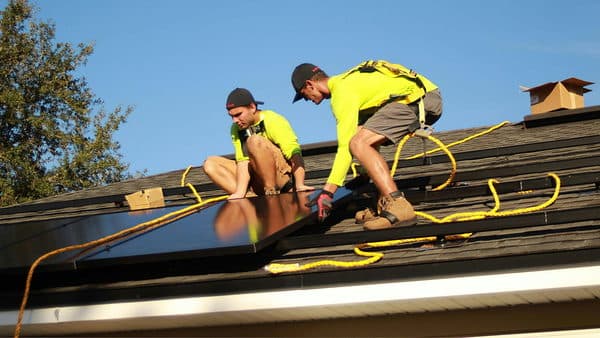
On installation day, the team fixes the mounting rails to the roof, attaches the panels, runs DC cabling to the inverter, and connects the inverter to your consumer unit. A competent-person certificate and an MCS installation certificate are issued on completion; you will need both documents to register for a Smart Export Guarantee tariff with an eligible supplier. From contract signing to a working system, most domestic installations take one to three days on site once permissions are in place, though the full timeline from agreement to commissioning varies by installer workload and DNO queue.
Prices and rates reviewed 30 June 2026
Join 50.000 others
Over 50.000 people have used one of our comparison sites to find the right supplier. Now it's your turn - find the right solar installer for your home.
Get quotes from solar installers