
Comparemypanels.co.uk
- Compare quotesGet several quotes with no obligation.
- One simple formJust tell us the essentials about your home.
- You stay in controlOnly go ahead if a quote suits you.

MCS-certified installers quote for your roof, free, no obligation.
Tell us about your home and your details.
Our partners get in touch with you.
You choose the quote that suits you best.
Find the right solar setup for your home.
A typical home solar system is worth around £410 to £470 a year on an east-facing or partly shaded roof, rising to around £605 to £675 a year on an ideal south-facing roof with no shading. Those figures combine electricity bill savings and Smart Export Guarantee payments, at June 2025 prices.
See how we calculated
Through us you get quotes from several installers, so you can choose the one that suits you best.
Get quotesAnswers to the most common questions.
A typical domestic system costs £5,000–£10,000 installed, depending on system size in kWp, roof type, battery storage and installer. That range covers the hardware, mounting, inverter and labour. VAT is currently zero-rated at 0% on residential installations to 31 March 2027, which reduces the net cost compared with the standard rate.
The typical payback period is 9–12 years on an ideal south-facing roof (Energy Saving Trust, Jul 2026 fuel prices). East-facing roofs or those with significant shading take longer. Payback depends on system size, how much of the output you consume directly, your electricity tariff and the Smart Export Guarantee rate you access, so any figure in a quote should state these assumptions explicitly.
The Smart Export Guarantee requires suppliers with at least 150,000 domestic customers to pay you for surplus solar power you export to the grid. The rate is set by each supplier, must be above zero, and varies widely, some tariffs are considerably higher than others. Comparing SEG tariffs from several suppliers after installation is worth doing, as it affects the long-term benefit of your system. Your installation must be MCS-certified to qualify.
Most standard rooftop installations in England fall under permitted development and do not need a formal planning application. Exceptions include listed buildings, properties in conservation areas and some flat-roof configurations. Rules vary across the four UK nations, so confirm the position with your installer before work starts, a reputable installer will check this as part of the survey.
VAT on residential solar installation is zero-rated at 0% to 31 March 2027 under current HMRC rules (VAT Notice 708/6). After that date the rate is scheduled to revert. If your installation is planned close to or after that date, check the VAT position with your installer and factor it into your total cost calculation.
Panels typically carry a product warranty of 20–25 years covering manufacturing defects and output degradation. Inverters are generally warranted for around 5–15 years. Separately, ask your installer for a workmanship warranty covering the installation itself, duration and scope vary between companies, and an insurance-backed version protects you if the installer is no longer trading when a fault appears.
Using this service costs nothing. You fill out one form, and MCS-certified installers get in touch with proposals for your specific home and roof. There is no obligation to accept any quote you receive. The service is commercially supported, meaning participating installers may pay to be part of the network, this does not affect the quotes you receive, which are based on your individual situation.
A typical domestic solar installation costs £5,000–£10,000, yet many homeowners commit to the first quote they receive without knowing whether a better one exists.
The right system depends on your roof's orientation, pitch and how much of the output you use directly. An installer who has sized dozens of systems in your area brings that local knowledge to the quote.
This page explains what shapes the price, when zero-rated VAT applies, and how to compare proposals on equal terms, so you can go into installation with clear numbers.
Below is a comparison of what each type is like.
Panels are mounted on your existing roof structure and feed power directly into your home; surplus is exported to the grid under the Smart Export Guarantee. This is the most common starting point for UK homes and tends to carry the lower upfront cost within the typical £5,000–£10,000 range. For SEG export payments to apply, the solar panel installation must be certified under MCS or an equivalent scheme; the export rate is set by your supplier and must always be above zero, but it does vary.
A battery stores surplus generation for use after dark, increasing the share of your own solar power you actually consume. The battery adds cost above the panel system itself and has its own warranty and degradation curve to factor into the payback calculation. This type of solar panel installation suits homes where evening demand is high or where grid import at peak tariff times is a concern. Check both the panel warranty and the battery warranty separately before you commit.
Where roof pitch, shading or orientation rules out a standard rooftop solar panel installation, panels can be mounted on a ground frame or on a flat-roof ballasted rack. Angle and orientation can be optimised, but planning rules vary by local authority and listed-building status must be checked before proceeding. Labour costs for this approach typically run higher than for a pitched-roof mount, so it is worth comparing quotes carefully to understand the full cost range for your situation.
Fill out one short form about your home and energy use, and a range of MCS-certified, quality-checked installers get in touch with concrete proposals sized to your roof and consumption. You compare the offers you receive at your own pace, free and with no obligation to proceed.
Every installer in the network holds MCS certification, so the installations they quote for will qualify for Smart Export Guarantee export payments. Pricing is presented on transparent terms so you can weigh up the real numbers rather than headline claims.
Get your quotes now and see what solar actually costs for your home.
The more kilowatt-peak capacity you install, the higher the hardware and labour cost, but a larger array also generates more, so sizing matters both ways. An installer will calculate the kWp your roof can carry and the output your consumption can absorb; oversizing beyond what you use directly reduces the return per pound spent, while undersizing leaves cheap generation on the table.
A standard pitched roof with good access is the straightforward case. Flat roofs need ballasted mounting frames, older tiles may need structural checks before any fixings go in, and difficult access adds scaffold or cherry-picker costs. These factors are assessed at survey stage, which is why a site visit before a final quote matters, ballpark figures shift once the installer sees the actual roof.
Adding a home battery to the system is the single largest optional cost step. The battery unit, inverter upgrade and installation labour all add to the total, and the payback calculation changes: the gain comes from higher self-consumption rather than higher export. Battery prices have fallen, but a system with storage will sit toward the higher end of the typical cost range, get the payback modelled separately from the panel cost.
Panel brand, inverter brand and installer labour rates all vary across the market. Premium panel specifications carry longer product warranties, panels typically 20–25 years, inverters around 5–15 years, and some installers include extended workmanship cover in their price. Comparing quotes on identical system specifications, rather than on headline price alone, is the only way to judge whether a lower quote reflects efficiency or a cut in specification.
Item | Value |
|---|---|
Typical payback period | 9–12 years (ideal roof; longer if east-facing or shaded) |
Typical panel/product warranty | panels typically 20–25 years; inverters ~5–15 years |
VAT on residential solar installation | 0% (zero-rated to 31 Mar 2027) |
Typical installed system cost (domestic) | £5,000–£10,000 |
Annual benefit incl. Smart Export Guarantee (up to) | £605–£675 a year with an ideal south-facing roof; £410–£470 east-facing or shaded (bill savings plus SEG export payments, June 2025 prices) |
Facts verified as of 2026-06-30.
Once you have chosen an installer and agreed a quote, the installer handles the paperwork first: an MCS-certified installer will submit the relevant grid-connection notification to your Distribution Network Operator (DNO) before installation begins, and will advise whether your property needs a formal planning application or falls under permitted development rules.
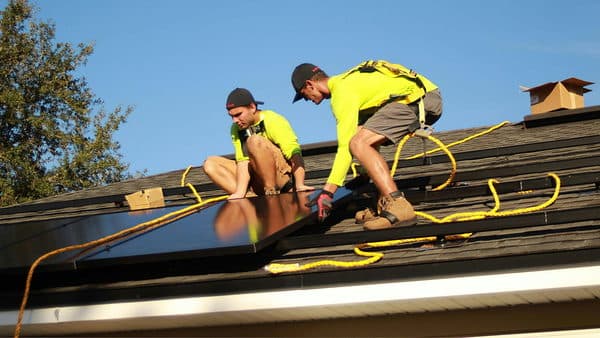
Installation itself typically takes one to two days for a standard pitched-roof system. The team mounts the racking, fits the panels, wires the DC cabling to the inverter and connects the inverter to your consumer unit. A generation meter or monitoring device is usually fitted at the same time.
After installation, your installer registers the system under MCS and provides the certificate you need to apply for Smart Export Guarantee payments with a licensed electricity supplier. Your DNO may carry out a brief inspection before export is activated. Keep all certificates and the installer's workmanship guarantee document, you will need them if you sell the property.
Prices and rates reviewed 30 June 2026
Join 50.000 others
Over 50.000 people have used one of our comparison sites to find the right supplier. Now it's your turn - find the right solar installer for your home.
Get quotes from solar installers